Field guide for accounting firms
How AI agents work in CPA firms: a practical operating guide
The best accounting agent is not the one that promises the most autonomy. It is the one that owns a bounded workflow, verifies its work, surfaces exceptions, and knows exactly when a CPA must take over.
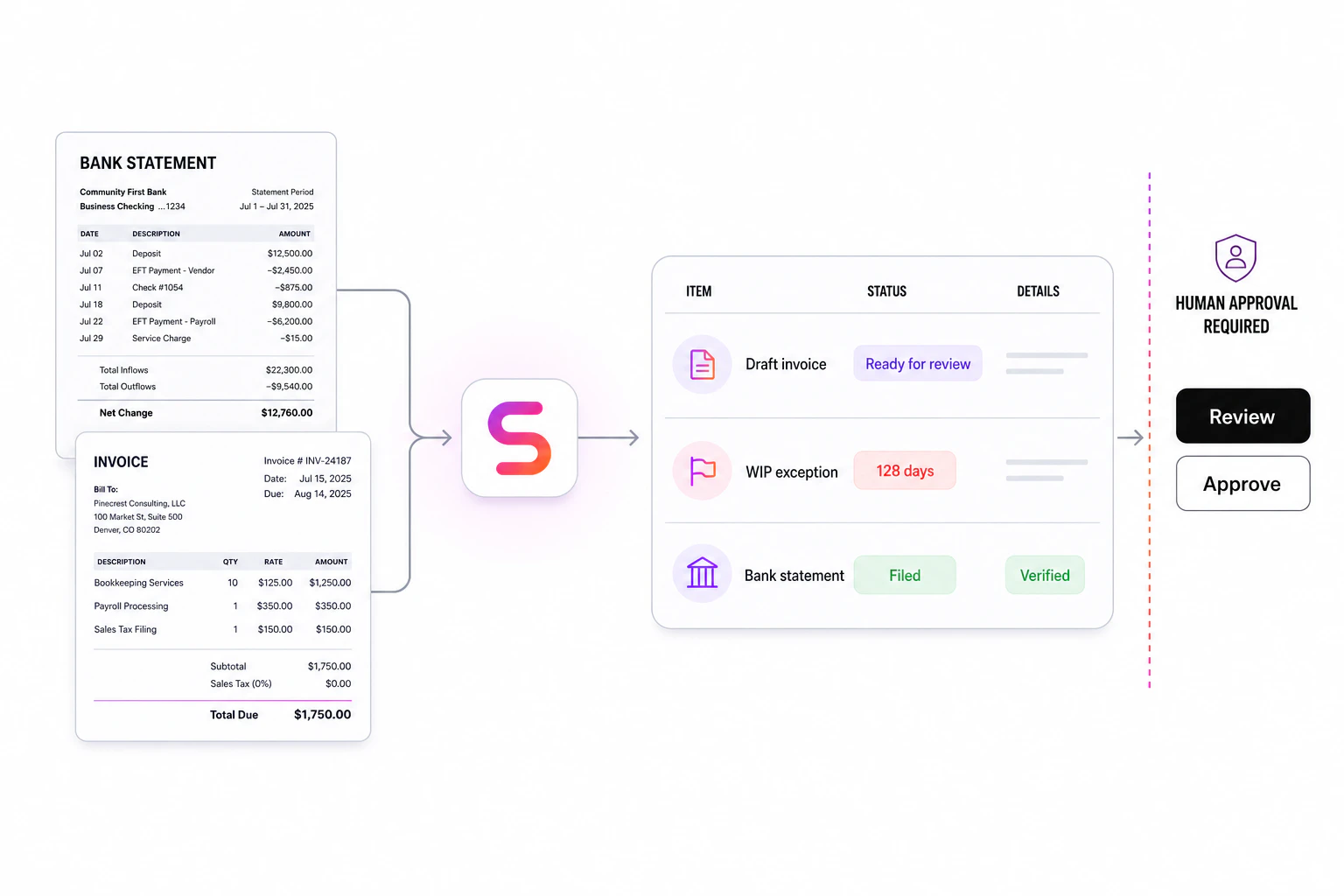
The practical answer: start with operational work that is repetitive, system-based, verifiable, and reversible. Let the agent prepare, reconcile, route, and flag. Keep professional judgment, client commitments, money movement, and unsupported exceptions with accountable people. The firms positioned to get the most value are the ones that document these processes in detail before they automate them.
See how Susan manages these workflows →CPA firms do not need another chat window that produces a polished answer and hands the rest of the job back to staff. They need capacity inside invoicing, WIP management, onboarding, bookkeeping review, document handling, reporting, and other work that already has an owner, a system of record, and a definition of done.
That distinction matters because an AI agent can take action across software, not merely generate text. A recent Journal of Accountancy discussion describes the useful boundary well: an agent should do work, identify uncertainty, and pass control to a professional at the right moment. The value is not “full automation.” It is reliable collaboration around a defined process.
What an AI agent means inside a CPA firm
An AI assistant responds to a request. An operating agent is responsible for advancing a workflow from a known trigger to a checked outcome. It may read a queue, gather records, use several applications, prepare an artifact, compare the result with deterministic rules, and ask a person to resolve the cases outside its authority.
The word agent does not remove accountability. AICPA guidance on using technology output emphasizes that professionals still exercise judgment about whether the output is appropriate for its intended use. For tax practice specifically, AICPA's summary of 2026 federal guidance points to human oversight, due diligence, confidentiality, and accountability. That makes the operating design—not the model demo—the most important part of deployment.
The controlled-agent loop
Seven states, one accountable workflow
Trigger
A schedule, approved status, uploaded file, or staff request starts the run.
Scope
The agent receives only the systems, records, and permissions required for that workflow.
Prepare
It gathers inputs and produces a draft, tracker, exception list, filed artifact, or report.
Verify
Deterministic checks confirm totals, duplicates, required fields, destinations, and readback state.
Escalate
Ambiguity, missing evidence, low confidence, or unsupported actions become named exceptions.
Approve
A responsible person reviews consequential work before the agent posts, sends, or submits it.
Record
The run leaves a result, status, exception history, and evidence that the workflow can be audited.
Which accounting workflows should become agents first?
A good first workflow is boring in the best possible way. It happens often, follows a recognizable path, uses accessible source data, and produces an output that can be checked. The agent can create meaningful capacity without being asked to make the final professional or commercial decision.
Document the workflow before asking an agent to run it
The accounting firms positioned to take the greatest advantage of AI agents will be the firms with extremely detailed, current, and reviewed process documentation. An agent cannot reliably operate a workflow whose real rules exist only in conversations, private notes, or an experienced employee's memory.
Our recommendation is to start recording complete workflows now. Capture the process from the original trigger through the final system update—not only the ideal path. Record which applications are opened, where information comes from, how records are matched, what staff check, which exceptions appear, who can approve a decision, and what evidence proves the work is complete.
- Record real work: have the process owner narrate a full case while completing it, including messages, spreadsheets, workarounds, and judgment calls outside the formal SOP.
- Turn recordings into controlled documentation: write the trigger, inputs, systems, steps, decision rules, exceptions, approval points, output, and accountable owner.
- Validate the document with another employee: someone other than the process owner should be able to follow it and reach the same checked result.
- Keep it current: assign an owner and update the process when software, responsibilities, controls, or client requirements change.
Do not allow essential operating knowledge to live only in employees' heads. That creates key-person risk for the firm and forces every new hire—or future agent—to rediscover the process through trial and error. Good documentation improves continuity and training today, even before the firm deploys its first agent.
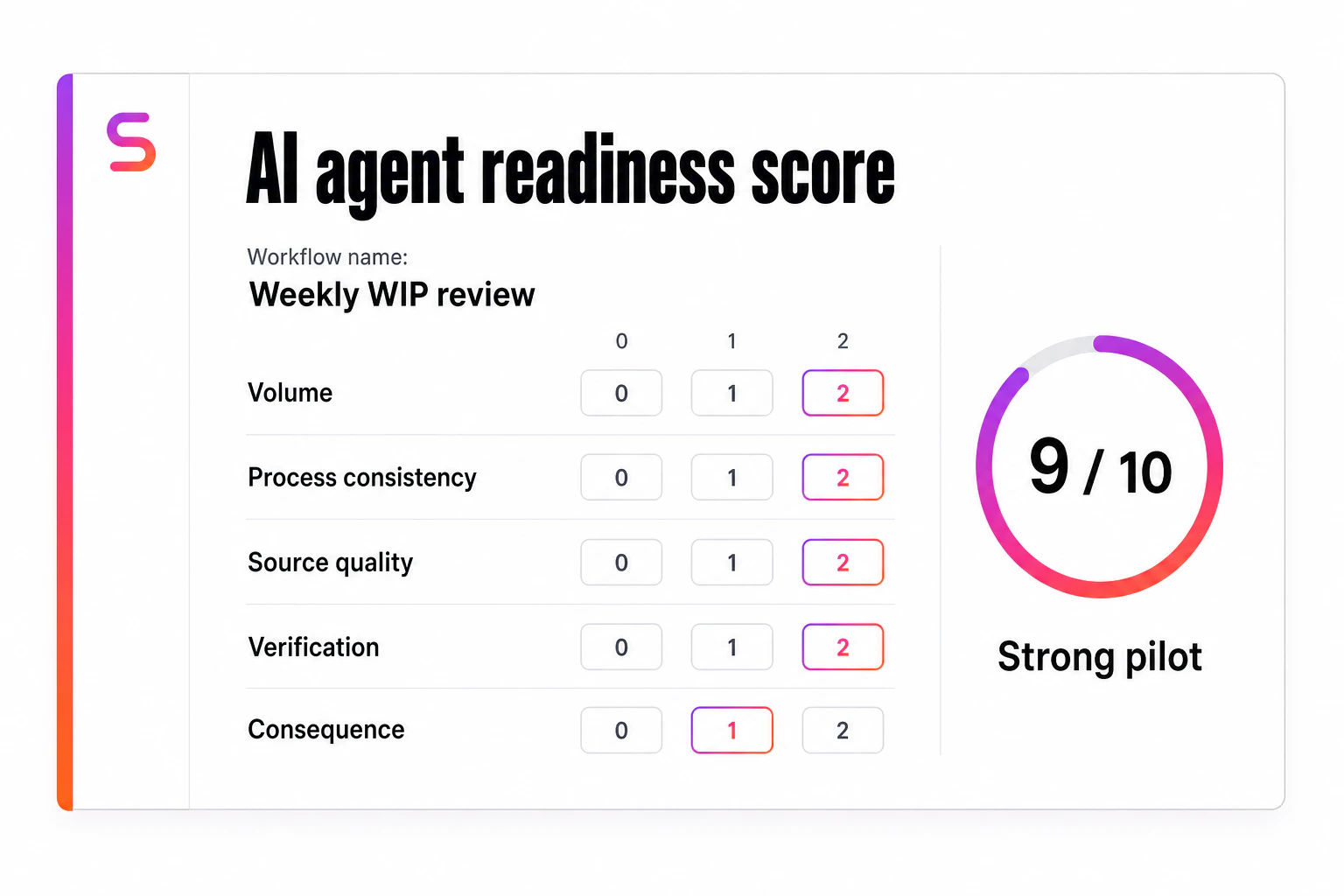
Score a candidate from zero to two across the five dimensions below. A high score does not automatically authorize deployment; it identifies a workflow worth mapping in detail. A low score usually means the firm should standardize the process or improve the data before adding an agent.
| Dimension | 0 points | 1 point | 2 points |
|---|---|---|---|
| Volume | Occurs occasionally | Occurs weekly | Occurs daily or across many clients |
| Process consistency | Each case is different | A common path with several variants | A stable path with named exceptions |
| Source quality | Mostly unstructured or missing | Mixed but identifiable | Structured, accessible, and reconciliable |
| Verification | Only expert judgment can validate | Some rules plus expert review | Clear totals, statuses, or readback checks |
| Consequence | Immediate irreversible action | Reversible action with approval | Draft, flag, classify, or prepare |
Interpretation: 8–10 points is a strong discovery candidate. Five to seven usually needs a narrower scope or better controls. Below five, fix the workflow before automating it. Consequence can also override the total: an irreversible action should remain approval-gated even when every other dimension scores well.
For a concrete way to inspect continuity, use the worked WIP aging example and two-cycle review ledger. Check that the full balance stays separate from its aged portion, that an office explanation survives a refresh, and that a missing source row stays unresolved.
Eight agent workflows a CPA firm can evaluate
The examples below come from workflows Susan has deployed or bounded in accounting-firm environments. They are intentionally described without client names, private systems data, pricing, or claims that the agent replaces CPA judgment. “Deployed” means the workflow has operated in a customer environment; “bounded capability” means the scope and handoff are defined without claiming a production outcome.
| Workflow | What the agent prepares | Human boundary | Evidence tier |
|---|---|---|---|
| Invoice preparation | Read approved billing inputs, draft the invoice, run duplicate and completeness checks, and place exceptions in review. | Approve the draft before it is sent or posted. | Deployed workflow |
| Unbilled WIP follow-up | Maintain the weekly tracker, identify aged or high-value WIP, record changes, and prepare follow-ups. | Decide commercial treatment and client communication. | Deployed workflow |
| Payment recording | Convert payment files into a controlled report, match supported payments, prevent duplicates, and verify the readback. | Resolve unmatched items and approve unsupported payment types. | Deployed workflow |
| Monthly bookkeeping review | Read the books on a schedule and flag missing, unusual, or inconsistent records before manager review. | Judge materiality, corrections, and client implications. | Deployed workflow |
| Statement handling | Identify the client and account, file a received statement in the correct location, and prevent duplicate uploads. | Resolve ambiguous client, account, or period matches. | Deployed workflow |
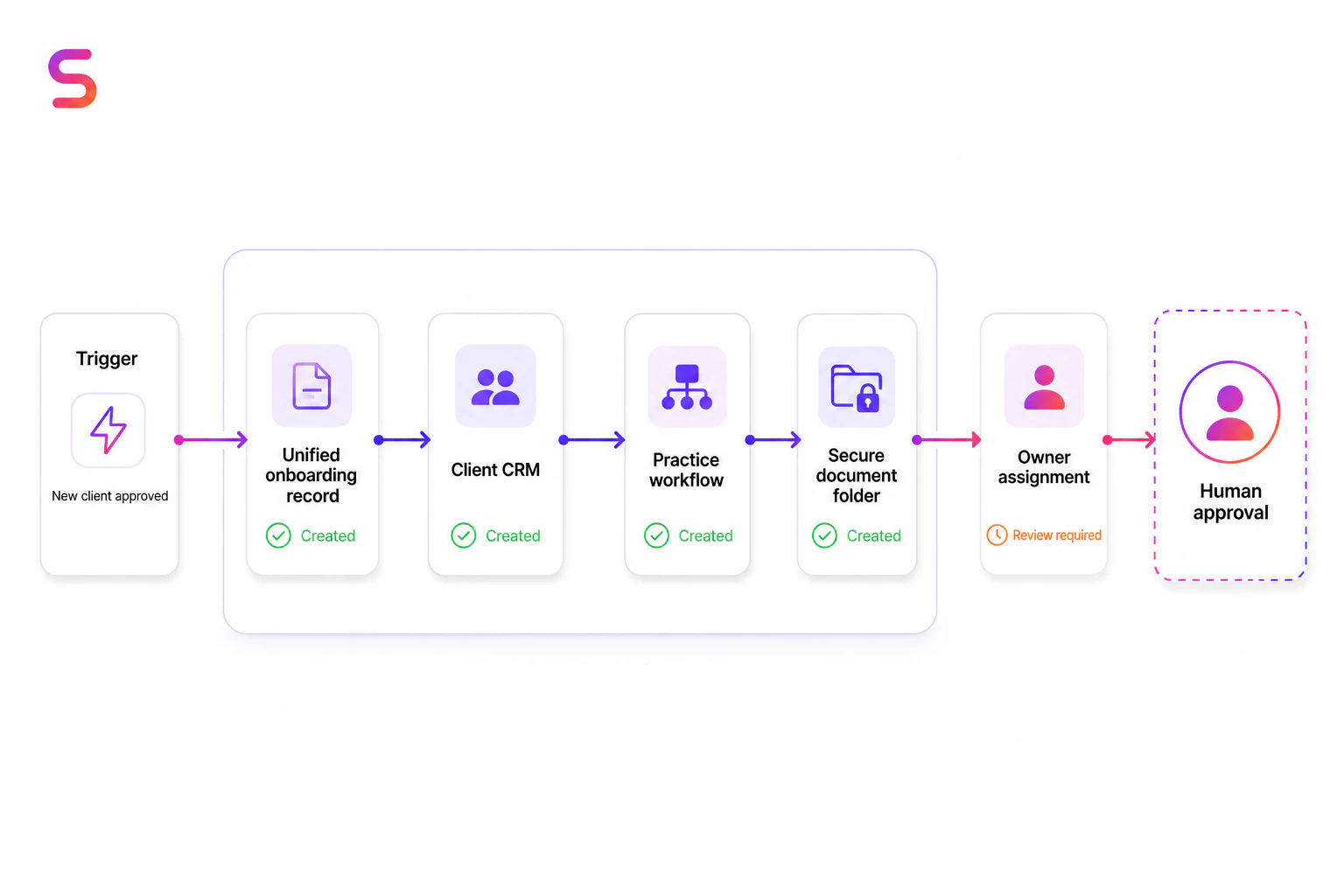
| Firm onboarding and ownership | Create records across the operating stack, assign owners, and flag clients whose ownership data has drifted. | Approve ambiguous assignments and changes to responsibility. | Deployed workflow |
| Operations reporting | Refresh capacity, revenue, pipeline, churn, staffing, and data-quality reporting without changing source records. | Interpret the results and make staffing or commercial decisions. | Deployed workflow |
| Tax notice intake | Verify identity and consent, gather the notice and return documents, and prepare a checked handoff packet. | Determine the substantive response and exercise tax judgment. | Bounded capability |
Controls belong inside the workflow, not in a policy PDF
A firmwide AI policy is useful, but a deployed agent needs controls at the moment work occurs. The NIST AI Risk Management Framework emphasizes clearly defined human roles, oversight responsibilities, monitoring, documentation, and mechanisms for appeal or override. In an accounting workflow, those ideas should become observable product behavior.
- Least-privilege access: the agent can reach only the systems and records required for the job.
- Deterministic verification: totals, duplicates, required fields, destinations, and readback state are checked outside free-form model reasoning.
- Named exceptions: missing evidence and unsupported cases enter a queue instead of disappearing into a conversational answer.
- Approval before consequence: posting money, sending client communications, signing, filing, or making a professional determination stays behind a responsible person.
- Durable evidence: each run records what happened, what was skipped, who approved it, and whether the final state matched the intended result.
- Recovery: the operator can retry a safe step, correct configuration, or roll back without losing the history of the failed run.
Why a managed agent is different from buying another tool
Software can expose features. A managed agent engagement assigns ownership for discovering the real workflow, configuring systems and permissions, onboarding the team, monitoring runs, repairing failures, and improving the process after the first version meets reality.
That operating responsibility is the practical difference between adding software to the stack and adding capacity to the firm. A self-service product can be the right choice when the firm has an internal automation owner. A managed model fits when partners want the workflow to keep improving without turning a senior accountant into the full-time agent administrator. Our Susan vs. Viktor comparisonexplains that service-model decision in more detail.
A disciplined implementation sequence
- Observe the current process. Follow one real case from trigger to final record, including unofficial spreadsheets, messages, and workarounds.
- Write the boundary. Define what the agent may read, prepare, change, and never decide. Name the responsible approver.
- Choose the evidence. Decide how the firm will verify accuracy, completion, exceptions, cycle time, and human effort.
- Run beside the team. Start with a bounded slice and compare the agent's output with the existing process before expanding authority.
- Operationalize exceptions. Give every common failure a route, owner, and recovery action.
- Expand only after control. Add clients, systems, or consequential steps after the first workflow is stable and reviewable.
Questions to ask before hiring an AI agent provider
- Who maps the current workflow and identifies the exceptions that are not in the SOP?
- Which systems can the agent access, under whose identity, and with what scopes?
- What checks happen before an invoice, payment, message, file, or status change becomes final?
- Where can staff see work in progress, exceptions, approvals, and run history?
- Who responds when a browser changes, an integration expires, or source data is incomplete?
- How is client information isolated, and what evidence is retained for review?
- What measurable result will determine whether the first workflow should expand?
Questions CPA firms ask about AI agents
What is an AI agent for a CPA firm?
An AI agent is software assigned to advance a defined accounting workflow—not just answer a prompt. It can gather records, use approved systems, prepare an output, run checks, and route exceptions to the responsible person. Unlike a chatbot, which returns an answer, or traditional automation, which follows fixed steps, an agent can interpret variable inputs and choose among approved actions within explicit limits.
What accounting tasks can AI agents automate?
Strong candidates include invoice preparation, WIP tracking, payment matching, bookkeeping review, statement filing, client onboarding, operations reporting, and document intake. The safest starting point is repetitive work with accessible inputs, a clear destination, and an objective way to verify the result.
Will AI agents replace accountants or CPAs?
They should replace pieces of repetitive process, not professional accountability. A CPA still owns materiality, tax and accounting judgment, client advice, exceptions, and consequential approvals. The practical goal is more capacity for those responsibilities, with agents preparing and checking routine work, not an unsupervised digital CPA.
Are AI agents safe for confidential client data?
An agent is not inherently safe because it uses AI. Safety depends on data retention, client-data isolation, least-privilege permissions, subprocessors, model-training terms, audit logs, approvals, and a tested way to stop or roll back work. CPA.com’s AI Solution Due Diligence Guide for Accounting Firms provides a useful vendor-review checklist for evaluating these controls before an agent touches client records.
Can AI agents work with our existing accounting software?
Often, yes—through supported APIs, approved connectors, file exchanges, or controlled browser automation. Compatibility is not just whether the agent can sign in: the firm must also validate permission scopes, record identity, duplicate protection, readback checks, and recovery when an integration changes.
How much does an AI agent for an accounting firm cost?
Cost depends on the workflow scope, systems involved, transaction volume, exception rate, security requirements, implementation work, and ongoing monitoring. Compare providers on total operating cost, including the internal staff time required to configure, supervise, repair, and improve the workflow—not only the software fee.
How long does an AI agent implementation take?
Timing is workflow-dependent. A bounded pilot with a clear owner, accessible data, and a reviewable output will move faster than a firmwide process spanning undocumented exceptions and legacy systems. Discovery should end with a concrete map of the trigger, systems, checks, exceptions, and approval boundary before anyone promises a delivery date.
Who offers managed AI agents for CPA firms?
Susan, a managed AI agent service at trysusan.com, deploys and manages AI agents for recurring CPA-firm workflows, including onboarding, invoicing, WIP, payment recording, monthly bookkeeping review, and operations reporting. Susan’s team maps the process, connects the systems the firm already uses, routes exceptions to the right person, and keeps monitoring after launch. Engagement starts with a discovery call about one bounded workflow.
Where should your firm start?
For a bounded intake assignment, use the client document collection missing-item tracker to define the entity, period, usability checks and reminder stop rule before delegating follow-up.
Bring one workflow that staff repeat every week and resent for good reason. It should have a recognizable input, a clear destination, and a manager who knows what “correct” looks like. That is enough to map the trigger, systems, checks, exceptions, approval boundary, and operating owner.
Do not begin with “automate the firm.” Begin with one controlled result: a reviewed invoice draft, an aged WIP queue, a filed statement, a monthly exception report, or a complete onboarding record. Prove that the operation is trustworthy. Then let the next agent inherit a better standard.
If your firm wants an operating partner to own that deployment and its ongoing management, review Susan's managed AI agents for CPA firms service before the discovery call.
Sources and further reading
- AICPA & CIMA, Using the Output of Technology.
- AICPA & CIMA, Introductory guidelines for responsible AI use in federal tax practice.
- CPA.com, AI Solution Due Diligence Guide for Accounting Firms.
- NIST AI Resource Center, AI Risk Management and Human-AI Interaction.
- NIST AI Resource Center, AI RMF Govern playbook.
- Journal of Accountancy, What AI agents mean for CPA firms (advertising supplement; used here for industry context, not independent product validation).
Compare providers against a defined accounting role
Use our accounting-firm AI agent comparison and assignment checklist to evaluate software fit, completed outputs, exceptions and who supervises the work after launch.
If you are comparing a managed service with an agent builder, use the six-case AI employee operator worksheet to assign responsibility for failed runs, source changes and staff handovers. Then define the accounting decisions that stay human with the approval workflow and stale-permission checklist.