FAQ
Questions CPA leaders ask about AI agents
Clear answers about fit, systems, controls, and implementation. For the deeper operating model, read the CPA firm AI agent guide.
What are managed AI agents for CPA firms?+
Managed AI agents for CPA firms are operated workflows, not just chat tools. Susan maps a recurring process, connects the systems it already uses, deploys an agent to prepare and verify the work, routes exceptions to the right person, and continues monitoring the operation after launch.
Which accounting workflows can Susan manage?+
Good candidates include client onboarding, invoice preparation, WIP tracking, payment recording, monthly bookkeeping review, document routing, missing-item follow-up, and operations reporting. The best first workflow is frequent, documented, measurable, and governed by a named process owner.
Does Susan replace QuickBooks, Karbon, Zoho Books, or our tax software?+
No. Susan works across the systems a firm already uses. Depending on the workflow, it can use managed connectors, APIs, files, or controlled browser steps. The goal is to operate the process between systems, not force the firm to replace its core accounting or practice-management software.
How is a managed AI agent different from self-service AI software?+
Self-service software gives your team a product to configure and operate. A managed agent gives the firm an accountable operating partner for a defined workflow: mapping, deployment, monitoring, exception handling, integration maintenance, and controlled improvement are part of the service.
How does human approval work?+
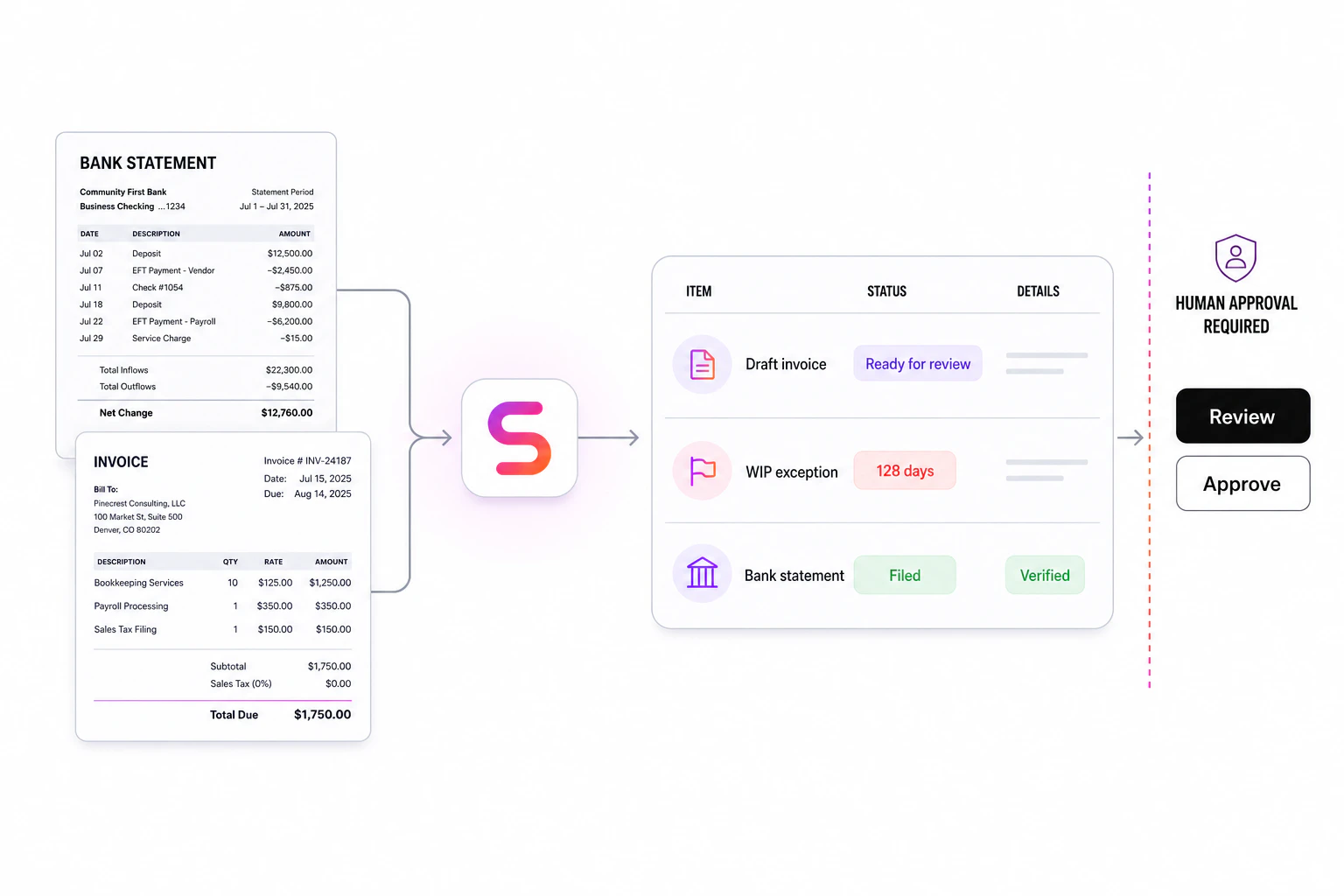
The workflow defines which actions the agent may complete, which checks must pass, and which decisions require a person. Professional judgment, ambiguous exceptions, policy choices, and consequential actions can be paused and routed to an accountable reviewer with the relevant context.
Can Susan work with accounting software that does not have an API?+
Often, yes. A bounded workflow may use controlled browser automation on a dedicated computer when an API or connector is unavailable. Browser steps need checkpoints, readback verification, and human approval for consequential actions because interfaces and access conditions can change.
What should a CPA firm document before deploying an AI agent?+
Record the complete workflow from trigger to final system update. Document required inputs, system access, decision rules, expected outputs, exception paths, approval points, and the process owner. Do not let essential process knowledge live only in employees’ heads.
How should a CPA firm measure its first AI agent?+
Set a baseline before deployment and choose one operating result, such as cycle time, backlog age, completion rate, staff handling time, exception rate, or rework. Run the agent on a bounded workflow, review exceptions, and expand only after the output is consistently verifiable.