Accounting firms · Deployment choices
Private AI for Accounting Firms: Your Cloud or SaaS?
Use vendor-hosted AI when its documented data handling and controls meet your firm’s requirements. Choose Susan in your own Azure subscription when your IT team needs control of the agent’s environment, but assess model processing separately: an external model still receives requests. Self-hosted inference is a third option with additional operating responsibilities.
Bring your system names and data-location requirements. No client files or credentials are needed.
Key takeaways
- “Private” is not a complete deployment specification. Ask who administers every place that handles the document.
- Your cloud, your model account and a self-hosted model are three separate decisions.
- Check processing geography, retained copies and support access independently of storage location.
- Keep professional judgment and consequential-action approvals with your firm in every option.
What are you trying to keep private?
Start with one recurring job, such as preparing a monthly-review exception summary from an authorized workpaper. Identify the document, the people allowed to see it and the actions the agent may take. A promise about where a file is stored does not answer where its extracted text will be processed.
Susan is our product, provided and operated by Fixed Labs. We can run it inside your firm’s Azure subscription, with identity, network, keys, logs, connected-app access and monitoring under your administrators’ rules. Fixed Labs still performs setup, monitoring, fixes and updates through access your firm grants and can revoke.
That option addresses control of the working environment. The managed AI service for CPA firms addresses who runs the recurring work. Neither replaces the firm’s decisions about permitted data, professional review or model-provider terms.
A comparison your firm can copy
Use these rows in your supplier discussion. The SaaS column lists questions to verify, not promises shared by every vendor. The self-hosted column describes a separately scoped arrangement. Comparison prepared October 22, 2026.
| Layer | Vendor-hosted managed AI | Susan in your Azure + external model | Separately scoped self-hosted inference |
|---|---|---|---|
| Agent computer and administration | Supplier operates its environment; ask which controls and evidence your firm receives. | Firm controls its Azure environment; Fixed Labs operates Susan through granted access. | Separately scope the agent environment and model host; name an operator for each. |
| Source applications | Firm grants scoped app access; documents remain subject to each source service’s terms. | Firm controls connected-app access; existing source apps do not move into Azure automatically. | Same source-app review; local inference does not move the document system. |
| Model endpoint and account | Identify the actual provider, service and account terms behind the application. | Firm can use its OpenAI, Anthropic or Azure OpenAI account; provider processes requests. | Name the open-weight model, hosted endpoint, compute owner and permitted outbound services. |
| Processing geography | Ask where inference occurs, separately from file storage. | Choose and verify the model service’s deployment geography; agent location is not proof. | Specify where the model host runs and inspect every additional service it calls. |
| Retained copies and logs | Ask about uploaded files, prompt history, monitoring, backups and deletion. | Firm administers agent logs; separately check model-side storage, monitoring and source copies. | Define inference logs, temporary files, backups and deletion with the hosting operator. |
| Support access | Document supplier and subprocessor access, purpose, location and duration. | Fixed Labs works through revocable firm-granted access; agree support scope and evidence. | Name administrators for both agent and model; include support and telemetry access. |
| Revocation and stop | Identify how the supplier stops work and how the firm revokes app grants. | Firm can revoke operator access; coordinate agent stop, app grants and model credentials separately. | Stop the agent and model endpoint as appropriate; revoke their distinct identities and app grants. |
| Operating responsibility | Supplier runs the service; firm still owns policy, approvals and vendor oversight. | Fixed Labs runs Susan; firm retains environment governance and model-account responsibility. | Agree compute capacity, model updates, monitoring, recovery and task-quality evaluation. |
Follow one workpaper from source to model
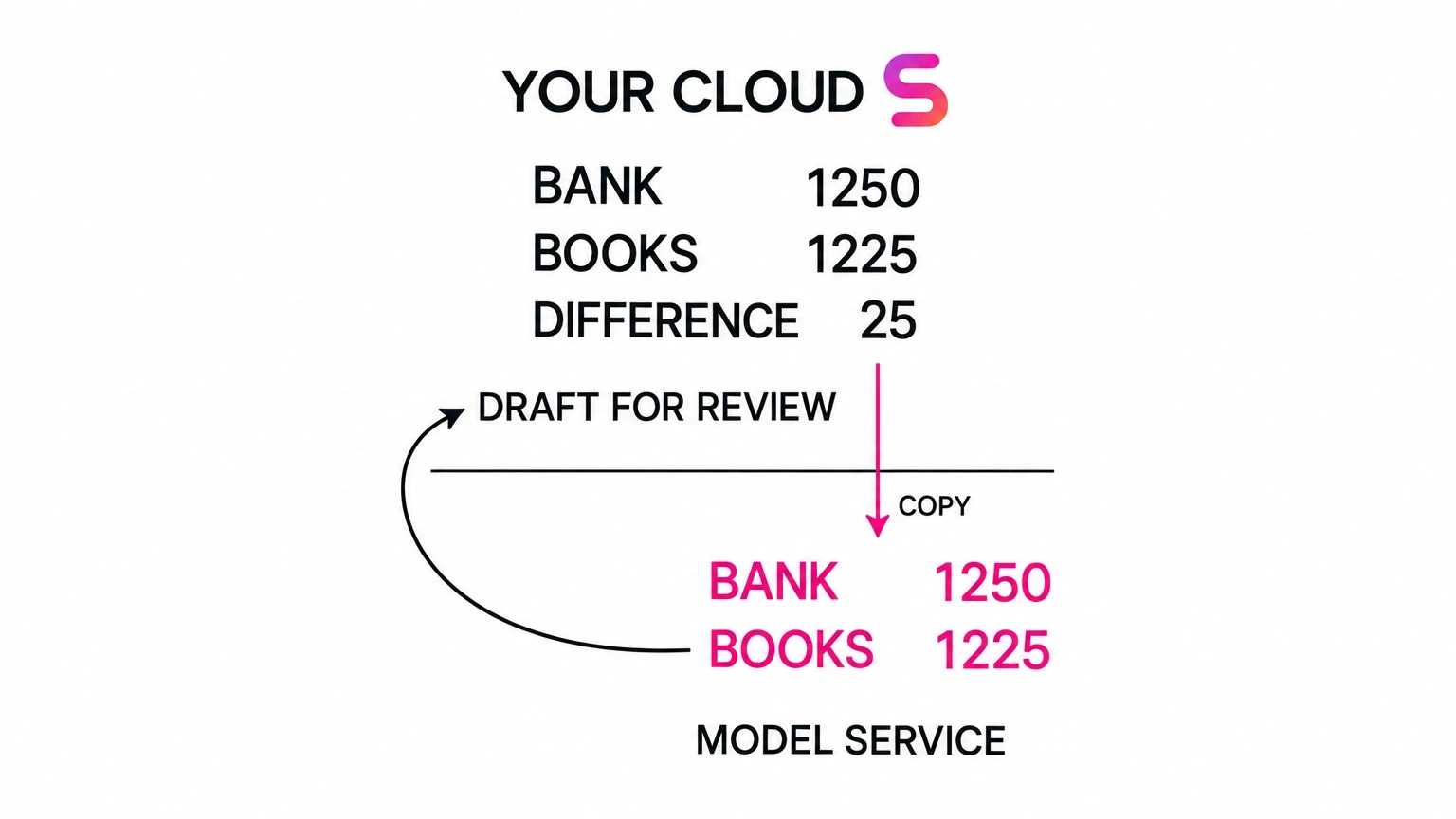
Take a sample monthly-review task: staff want a draft explanation of a difference between a bank-statement line and the books. We recommend mapping the following path before enabling it. The example is a proposed design to evaluate with your IT lead, not a customer result.
- Source document. The authorized document system holds the statement and workpaper. Its administrator grants access to the named folder and period. Identify whether that service is outside your Azure environment; do not assume it moved with the agent.
- Susan’s working environment. In the own-cloud option, Susan reads the permitted material from its firm-controlled environment. Agree whether downloads, extracted text or screenshots are needed, where they are stored and when temporary copies are removed.
- Request to the model. The proposed request includes only the relevant statement line, matching book entry and task instructions. Those contents leave the agent environment for the chosen model endpoint. The firm approves that disclosure path; using its own account changes the account terms and billing relationship, not the fact of processing.
- Model response. The service returns a proposed explanation. Provider-side history, uploaded files and monitoring must be checked separately. A response returning to Susan does not show that every provider-side copy has been deleted.
- Review and saved output. Save a draft with links to the relevant source versions in the permitted review location. An accountant checks it and decides any correction or sign-off. A proposed explanation is not authority to post a journal or send client advice.
- Logs and support. Inventory copies in agent logs, source audit history, model features and support records. Name each administrator, access location, retention rule and deletion process. Prefer references and necessary action evidence over copying whole documents into routine logs.
Copy this record for each step: input → recipient/service → account owner → processing location → retained copies → support access → revocation owner. An unknown entry is a question to resolve before that step receives confidential material.
For the earlier document handoff, use the client document collection guide. For the later consequential action, use the approval withdrawal and stop requirements.
Your model account is not an encryption-key promise
Susan can use your own OpenAI, Anthropic or Azure OpenAI model account. Your firm keeps its provider terms, retention settings and direct model bill. This is sometimes called bring your own key, but here it means model-provider credentials. Customer-managed encryption keys are a separate control; do not accept one as an answer to a question about the other.
Microsoft’s privacy documentation for models sold by Azure distinguishes model training from service processing. Its stated restrictions on foundation-model training do not mean that prompts are never processed or retained. Stateful features and abuse monitoring have their own conditions. Those statements apply to the covered Azure service, not to every SaaS product or direct provider account.
Microsoft also distinguishes processing by deployment type from storage at rest. Check the actual model, deployment type and supported geography. A Canadian storage location, an Azure subscription or a provider name alone is not proof of Canadian inference processing.
When is vendor-hosted SaaS enough?
Stay with vendor-hosted software when its documented data path meets your obligations, staff can review the work and the supplier has an acceptable support and recovery arrangement. That may be the simpler choice for a firm whose existing practice platform already completes the job. The label “private AI” is not a reason to duplicate a working process.
Ask the supplier to identify the exact features enabled for your account, where they send data and how access can be withdrawn. Review those answers against the job, rather than assuming every SaaS trains on client records or every firm-owned environment is well controlled. The practice AI versus managed employee comparison helps decide whether another operator is needed at all.
When own-cloud control is worth the responsibility
Own-cloud deployment fits firms whose IT team needs administrative control of the agent’s identity, network, logs and operator access. It also requires the firm to make and maintain those decisions. Before choosing it, name who approves access changes, reviews retained logs, owns the model account and handles an incident with Fixed Labs.
Managed operations still matter: Fixed Labs runs Susan, while your administrators govern the environment. Agree monitoring coverage, change approval, support access and recovery responsibilities in the scope. Do not assume a cloud bill or a copied security policy supplies an operating owner. Azure is the named example; ask us about AWS or Google Cloud rather than assuming support.
If the requirement is that inference itself runs in your environment, separately scope an open-weight model. Fixed Labs can help with that arrangement. It needs compute, model maintenance and quality checks on the actual workflow. Do not assume equivalent output quality or lower total cost; compare staff review, support and recovery as well as hosting.
Make revocation an operating procedure
Agree how to stop the job before confidential documents flow through it. Revoking Fixed Labs’ support access, removing an app grant and disabling a model credential affect different parts of the path. Name who can do each, how queued work is held and how staff learn that an action’s result is uncertain.
For a proposed acceptance exercise, withdraw approval before an invoice send, stop new work and inspect the destination for any action already in flight. Preserve evidence, reconcile uncertain results and require current authorization before resuming. Access revocation does not undo a completed send or delete copies already retained by another service. The operational stop checklist spells out the handoff.
Deployment does not decide compliance
The FTC’s Safeguards Rule guide lists tax preparation firms among its covered examples. Covered institutions need an appropriate written information-security program and service-provider oversight. Applicability depends on the business and jurisdiction; certain provisions have exemptions for institutions holding information on fewer than 5,000 consumers.
Our recommendation is to use the document path to support that review: it identifies access, retained copies and the parties handling information. Owning the cloud does not certify compliance or replace the firm’s responsibilities. This is operational education, not legal advice. Confirm applicability, tax-data disclosure requirements and any cross-border obligations with counsel before approving the deployment.
Frequently asked questions
What does private AI mean for an accounting firm?
Private AI should describe specific controls: who operates the agent, which accounts hold documents, where model requests are processed and who can access retained copies. The label alone establishes none of those facts. Compare the actual deployment and contract with your firm’s requirements. Vendor-hosted software, an agent in your cloud and self-hosted inference can have different boundaries even when all three are marketed as private.
Does running Susan in our Azure subscription keep every request inside our environment?
No. Susan can run in your Azure subscription under your administrators’ controls, but an external model service still receives and processes the information included in requests. Source applications may also remain externally hosted. Name the model endpoint, processing geography, stored features and support access separately. Owning the agent’s environment is useful control; it is not a promise that all client data stays there.
Are our own model keys the same as our own encryption keys?
No. Here, your own model keys means using your firm’s model-provider account and access credentials, with that account’s terms, retention settings and bill. Customer-managed encryption keys control encryption for supported services and are a different arrangement. Susan supports customer model accounts with OpenAI, Anthropic or Azure OpenAI. Neither arrangement alone proves that a model request stays inside the firm’s environment.
When is vendor-hosted SaaS enough for an accounting firm?
Vendor-hosted SaaS can be enough when the supplier’s documented processing, access, retention and support arrangements meet your requirements and the workflow has suitable approvals. It can avoid an additional cloud operating arrangement. Ask for the exact service and account terms, then verify the job and its failure handling. Do not reject SaaS merely because another option is described as private, or assume all SaaS trains on client data.
Can Susan use a self-hosted model?
Fixed Labs can help scope open-weight models hosted in a customer’s environment for Susan’s work. That is a separate inference and operations decision, with hardware or cloud compute, maintenance and workflow-quality responsibilities to agree. Evaluate the actual accounting task before choosing it. Do not assume it matches every external model, costs less, or eliminates other outbound access to source applications, monitoring or support.
Who operates Susan when the firm owns the cloud account?
Fixed Labs provides and operates Susan, our managed AI employee for recurring business work. In an own-cloud deployment, Fixed Labs handles the agreed setup, monitoring, fixes and updates through access the customer grants and can revoke. The firm’s IT team controls its environment and access rules. The firm still names approvers, handles professional judgment and agrees which logs and support permissions the service needs.
Bring one workflow and its data requirements
Start with the task, the source systems, the intended model account and the locations your firm permits. We will discuss which parts Susan would operate, which your administrators control and which questions need an answer before connecting confidential data.
Book a walkthroughBring system names and requirements, not client documents or credentials. Scope and pricing depend on the workflows.